Mies
was born in Aachen,Germany in 1886. He learned his father's trade of stonemasonry.
He had the privilege of working as an assitant for Peter Behrens in Berlin for
a couple of years until he started his own practice. In 1929 he built the German
Pavilion for the Barcelona World's Fair. This was one of his most significant
works of architecture. He also directed the Bauhaus School in Germany for a
couple of years until he closed it down because of the war. He then was offered
a job in Chicago, Illinois at the Armour Institute (which is now the Illinois
Institute of Technology). During his time at IIT he was able to design a new
campus, but was only able to build part of it because of a lack of funding.
He had his own practice in Chicago also during which he built the Farnsworth
House, 860-880 Lake Shore Dr. Apts.,Crown Hall, IIT, and the Seagram Building
in New York City, New York. His architecture was the cutting edge of technology
and modernism at the time when it was built and is still considered some of
the greatest architecture of the 20th century.
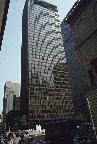
The
Seagram Building in New York City is similar to many of the other skyscrapers
that Mies designed.
Mies
was proud of his furniture that he designed.
Mies
was a very detailed architect. His stairs, corners, and other details were always
perfect.